Commissions that calculate themselves, and why reps stop arguing about them
Commission day follows the same pattern in almost every field-sales operation: the rep shows up with his notebook, the office shows up with its report, and the two numbers do not…
Commission day follows the same pattern in almost every field-sales operation: the rep shows up with his notebook, the office shows up with its report, and the two numbers do not match. Half an hour later nobody can remember which customer the difference came from.
The expensive part is not the half hour. It is that it repeats every month, with every rep, and that while it lasts the rep is convinced the company is taking something from him. A team that does not trust the math behind its own pay sells worse.
The argument is almost never about the percentage
When a rep argues about his commission, he is almost never arguing about the 5 %. He is arguing about what went into the calculation: whether that August invoice counts, whether the return from the customer who refused delivery got deducted twice, whether the order he took but somebody else delivered is his.
He is arguing about the base, not the rate. And the base is the part that is almost never written down precisely. The percentage gets agreed on day one and everybody remembers it; the rules for what adds and what subtracts get decided as you go, month by month, and shift depending on who builds the report.
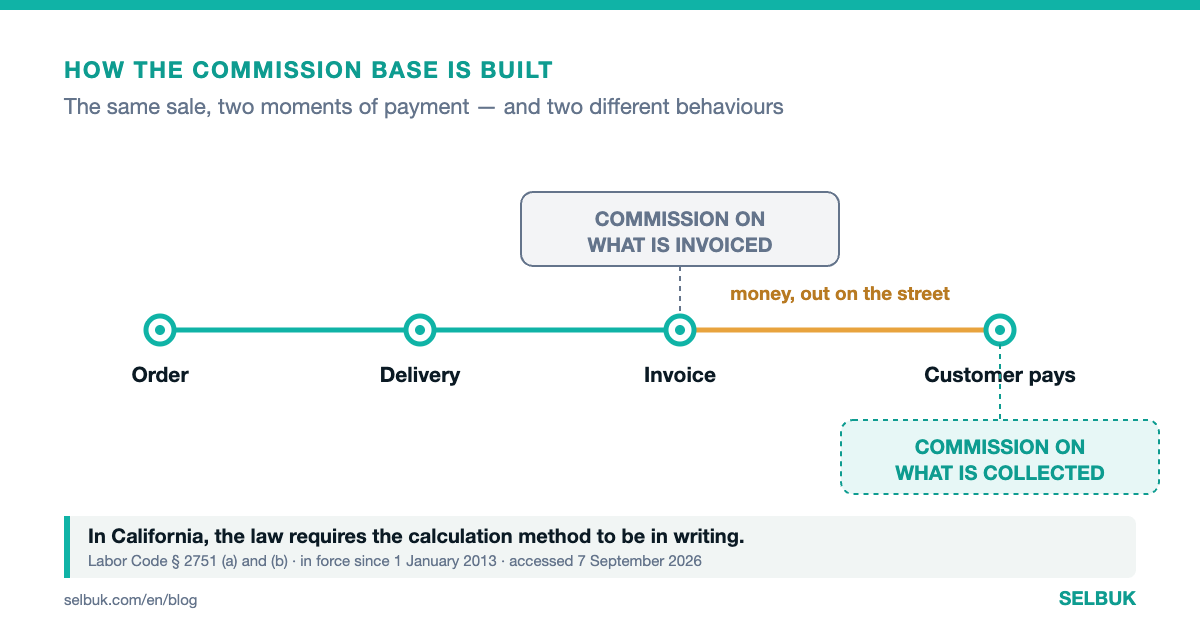
Invoiced or collected: the decision that settles everything else
There are two ways to build the base, and it is worth choosing one deliberately, because the choice changes the behaviour of the whole team.
Commission on what is invoiced
It gets paid when the invoice is issued. It is simple, it is fast, and the rep understands it without anyone explaining it. The problem shows up later: the rep does not care whether the customer pays. His job ended at the door, and receivables are somebody else's problem.
Commission on what is collected
It gets paid when the money comes in. The rep stops selling to customers who do not pay, because selling to them earns him nothing. It takes more explaining and it delays his payout, but it lines the rep up with the only thing the company actually cares about.
Most route operations that carry their own receivables end up on the second one, or on a mix: part at invoicing and the rest at collection. What does not work is never having decided, and settling each case as it comes up with the rep standing there.
What makes a calculation stop being argued about
A commission stops being a topic of conversation when it meets four conditions. None of the four is about software: they are about design. The tool only makes them sustainable month after month.
- It comes from the same source as the sale. If the sale lives in the system and the commission is worked out on a separate spreadsheet, the two drifting apart is only a matter of time.
- It is visible during the month, not at the end. A rep who checks his running total on the 12th can still change course. One who sees it on the 30th can only complain.
- It carries line-by-line detail. Not "$420,000". Which documents, from which customers, for how much, and what was subtracted. The argument ends when somebody can point at the row.
- The rules are written before the period starts. What happens with returns, with advances, with the customer who pays half, and with the order one rep took and another delivered.
The fourth is the one most often skipped and the hardest to do. The first three are solved by tooling; that one is solved by writing, and it has to be written before the odd case appears, not on the day it does.
Putting the agreement in writing is not a formality
In California, section 2751 of the Labor Code requires that any employment contract whose contemplated method of payment involves commissions be in writing and set out the method by which the commissions are computed and paid. The employer must also give the employee a signed copy of the contract and keep a signed receipt for it.
That is a local obligation: it covers services rendered in that state and has been in force since 1 January 2013 (official text of the section, accessed 7 September 2026).
But the underlying idea travels to any country: a calculation method that is written down and handed over protects both sides. The rep knows what to expect, and the company has something to answer with when somebody raises a claim six months later.
What happens to receivables
When commission is paid on what is collected, collections stop being an admin task and become the rep's own interest. Nobody has to chase him to call the late-paying customer: it is his own money sitting out on the street.
The side effect is more interesting still. The rep starts filtering before he sells. He stops loading merchandise onto the customer who is already carrying three overdue invoices, because he knows that sale will pay him nothing and will mess up his month.
That filter, applied by the person who knows the customer and is standing at his door, usually works better than a credit policy decided at the office from a two-week-old report.
What to measure
- Commission claims per period: how many, and from which rep. It is the direct measure of whether the calculation is understood.
- Days between period close and payout: past a week, the rep loses the link between what he did and what he was paid.
- Difference between calculated and paid: this should be zero. If it is not, there are manual adjustments, and that is where most claims come from.
- Commission on invoiced versus commission on collected: the gap between the two is the real size of your receivables problem.
The last one is the most useful and almost nobody looks at it. If a rep generates a hundred in commission on invoiced and sixty on collected, that forty is not a commission problem: it is a problem with who he is selling to.
A rep does not argue with a commission he can audit himself. He argues with the one that arrives finished, as a round number, with no detail behind it.
Where to start
Do not start by moving the base from invoiced to collected. That change hits the team's pay and needs notice, a transition and probably a mixed period. Doing it from one month to the next reads as a pay cut, and rightly so.
Start with what costs you nothing: let every rep see his running total for the month, with the detail of the documents behind it, whenever he wants and without asking anyone. On that alone, commission-day claims drop before you change a single rule.
Then write down the rules for the odd cases, while there is no odd case on the table. It is far easier to agree on what happens with a return during a quiet month than on the day there is a large return and a rep waiting for an answer.
This article is information, not legal, accounting or employment advice. Commission and wage rules vary by country: confirm them with your lawyer or your accountant.