The customer who buys a little less every month, and nobody notices
Almost no customer leaves overnight. First they stop ordering one product. Then they order every three weeks instead of every two. Later the order gets smaller and nobody says…
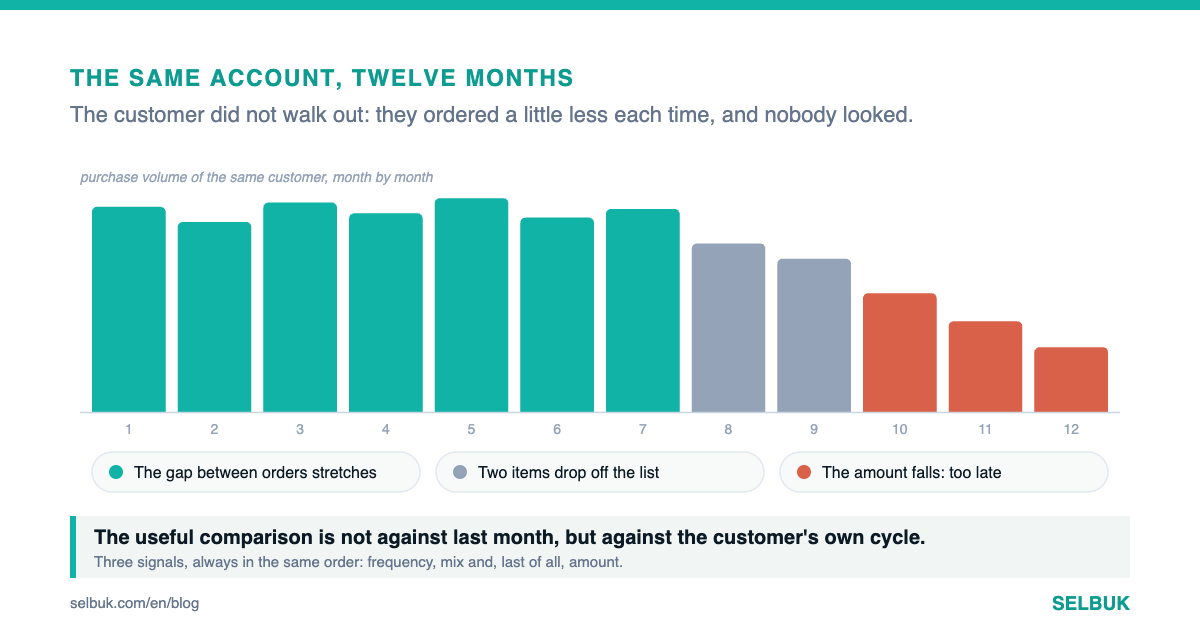
Almost no customer leaves overnight. First they stop ordering one product. Then they order every three weeks instead of every two. Later the order gets smaller and nobody says anything about it. The day you call and hear they buy from someone else, they had been leaving for four months.
The uncomfortable part is that this leak almost never shows up in the sales report. The monthly total can go up while twenty accounts quietly fade, because three large orders cover for twenty small ones. The number you check every Monday is built to hide exactly this problem.
Nobody leaves all at once: they leave in three signals
A customer on the way out sends three warnings, and sends them in this order. First the frequency changes: the gap between orders stretches. Then the mix changes: two or three items drop off and only the basics remain. The amount falls last.
Most teams only watch that third one, which is the last to appear and the hardest to reverse. By the time the amount drops visibly, the customer has already tried your competitor, it already worked, and the habit has already changed. The first two signals arrive weeks earlier.
| The signal | What it actually means | What to do on the next visit |
|---|---|---|
| The gap between orders stretches | They buy the same volume, but part of it from someone else | Ask what is turning over more slowly; do not lead with a discount |
| Two or three items disappear | Somebody got in through that specific category | Review price and display for those items, not the whole range |
| The order gets smaller | They already switched main supplier | Win back one category, not the whole account |
| They order the same thing every time | Buying out of habit, with no real loyalty | Try one new item in a small quantity |
Why the monthly report does not show it
There are three reasons, and all three are about shape, not substance. The first is averaging: once you add up the whole book, the account that dropped thirty per cent vanishes inside the total. The second is the monthly cut, which slices buying cycles in half and makes them unreadable.
The third one is more human. The rep who covers that account almost always has a reasonable explanation ready: they were doing inventory, the owner was out, they ordered last week. Each explanation is true on its own. Lined up across four months, they are something else entirely.
The calculation almost nobody runs
The useful comparison is not against last month, and not against the team average. It is against the customer themselves. Every account has a natural buying cycle — seven days, fifteen, thirty — and that cycle is its baseline. What matters is how far it has drifted from its own.
A customer who buys every fifteen days and has gone twenty-two without ordering is in trouble even if the account is small. A customer who buys every sixty days and has gone forty is fine even if the account is large. Account size says nothing about risk.
Without that individual baseline, every customer list sorted by revenue leads to the same place: visiting the big accounts and losing the middle ones. And the middle ones, added up, usually weigh more than the three big names filling the calendar.
| Customer | Their normal cycle | Days without ordering | How to read it |
|---|---|---|---|
| Weekly buyer, small amount | 7 days | 19 | Urgent: nearly three cycles missed |
| Fortnightly buyer, mid amount | 15 days | 16 | Normal: still in rhythm |
| Monthly buyer, large amount | 30 days | 47 | Watch it: a cycle and a half |
| Irregular buyer, mid amount | No stable cycle | — | Do not measure by time: measure by mix |
What changes on the visit
When the rep walks in with this information, the conversation changes shape. They do not open by asking what the customer needs today, which is the question that invites a repeat of the last order. They walk in knowing what stopped being ordered and since when, and ask about that specifically.
That question does something no promotion can: it forces the customer to say out loud why they changed. Sometimes the answer is a price. Very often it is something you can fix during that same visit — a late delivery, an item that ran out twice in a row, an invoice charged wrong.
The difference between saving an account and losing it is almost never the offer. It is how many weeks it took you to notice something had changed.
Winning back costs less than winning new
A customer who already buys from you has settled the three most expensive parts of a sale: they know who you are, they carry your products on their shelf, and payment terms are agreed. Recovering one category inside that account is a single visit's work.
Opening an equivalent new customer is months of work, with visits that close nothing, terms to negotiate and an initial range you have to build item by item. The book you already have is almost always the cheapest place to look for this quarter's growth.
What to test on Monday, without buying anything
- Take your twenty steadiest customers and write down, for each, how many days passed between orders six months ago and how many pass now. That list is your real exposure.
- Pick three accounts and compare the line detail of an order from six months back with the latest one. Look at which items vanished: that is the category you lost.
- Ask a rep, with no warning, which of their customers has gone longest without ordering. If they do not know it by heart, that number exists nowhere.
- Flag every customer more than two of their own cycles past due and put them on this week's route, even if the territory says otherwise.
- For one month, open every visit by asking about what stopped being ordered. Write the answer down. You will hear the same reason repeated more often than you expect.
What has to be in place
None of this runs on memory. It needs three things on record: order history per customer with the line detail, each account's own cycle, and an alert that fires when someone drifts past their rhythm. If all three live in the rep's head, they walk out the door with the rep.
You do not need a complicated system to start. You need orders captured with their date and their detail, and someone looking at that list once a week. The team that runs that twenty-minute review finds two or three accounts every month that were quietly on their way out, and gets there in time.