The order that lives in a chat: what you lose when your history is a conversation
The rep is standing at the customer's counter. He opens WhatsApp, types "send me ten of the usual and four cases of water", the customer replies with a thumbs up and the order is…
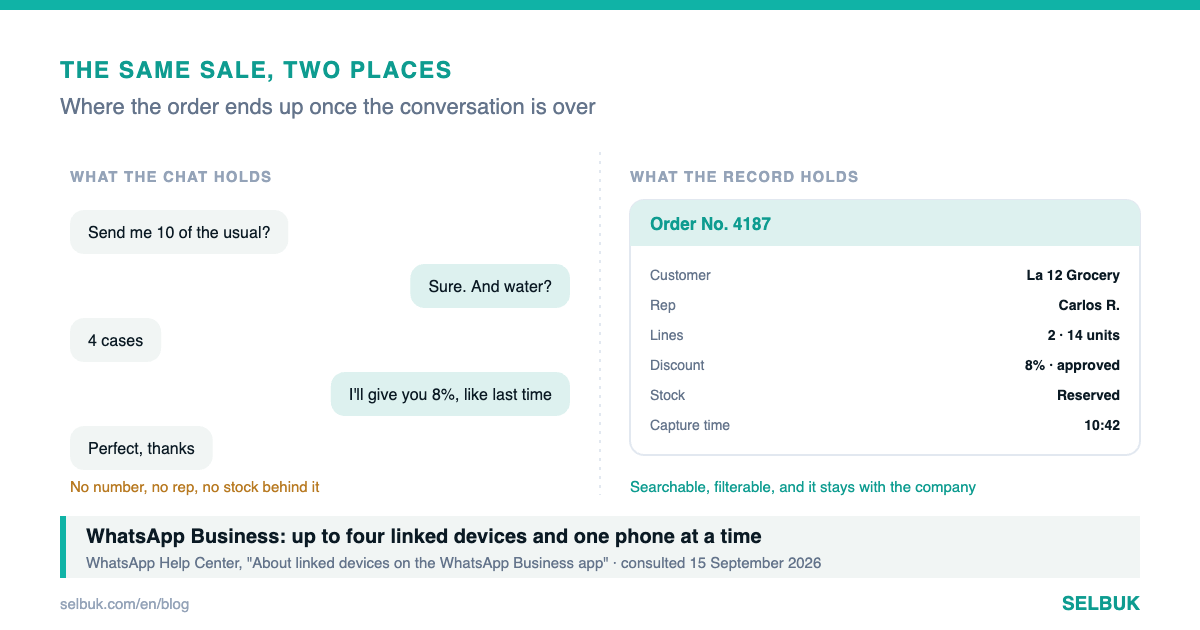
The rep is standing at the customer's counter. He opens WhatsApp, types "send me ten of the usual and four cases of water", the customer replies with a thumbs up and the order is closed. It took forty seconds and nobody had to install anything. That is why WhatsApp wins so many arguments before they start.
The problem shows up three months later, when somebody asks how much that customer bought last quarter, who approved the 8% discount and why the shipment went out short. The answer exists. It is spread across four thousand messages, inside one person's phone.
Where WhatsApp wins, and it really does
This is worth saying before any criticism. The customer is already there: nobody has to talk him into installing an app or learning a new screen. He writes at whatever hour suits him, sends a photo of the empty shelf and sees when he was answered. On friction, no field tool competes with that.
And the channel is cheap to run. WhatsApp publishes that it does not charge for service messages, nor for utility messages a business sends in response to the user, and that every customer message opens a twenty-four-hour service window that resets on its own. If the customer writes first, answering costs nothing.
One number is a single identity
Here is where the other side starts. A WhatsApp Business account is a phone number, and that number is one identity. Its own help page publishes the limit: up to four linked devices and one phone at a time. With three reps on the street, either they share the number or each one carries his own.
Both exits hurt. If they share it, nobody knows who promised what: the history says "we". If each carries his own, the customer ends up with three separate threads open with the same company, and the company holds none of the three. Each phone holds one.
Linked devices are not a work team either. WhatsApp warns on that same page that linked devices disconnect by themselves after thirty days of inactivity, that broadcast lists cannot be created or viewed on them, and that there is a known issue where some of them do not show up to a year of chat history.
The questions of any given Monday
| The question | In the chat | In a field CRM |
|---|---|---|
| How much did this customer buy in ninety days? | Add up four thousand messages by hand | One filter by customer and date |
| Who approved that discount? | Whatever the person who gave it remembers | Rep and limit, inside the document |
| Was there stock when it was promised? | Unknown | The order is taken against inventory |
| What number does that order have? | None | The one the system gave it |
| The rep quit — what about his accounts? | They left with the phone | The customers stay in the database |
A history is not a database
A chat is a list of messages ordered by time. A database is a list of facts ordered by whatever you want to ask it. They look alike while there are twenty customers. At two hundred, finding "the last time this customer ordered cookies" stops being a search and turns into archaeology.
The detail that settles it is that the document does not exist in a chat. There is no order number, no status, no committed delivery date, no total calculated against the price list. There is a sentence agreed between two people. A sentence does not ship itself and does not invoice itself.
The useful question is not "can you sell on WhatsApp?". You can, and very well. It is "where does the order end up once the conversation is over?".
What each one charges today
Neither of them hides its prices, and they do not charge for the same thing: one charges per delivered message and the other per user per month. Comparing the final bill means knowing how many messages go out, so the honest move is to put down what each one publishes.
| Item | What you pay | Source |
|---|---|---|
| WhatsApp Business Platform | Per message delivered, not sent; the rate changes by market and category | WhatsApp Business pricing page |
| Service messages | No charge, inside the 24-hour window each customer message opens | WhatsApp, same page |
| Ad that clicks to WhatsApp | 72 hours free across all message categories | WhatsApp, same page |
| SELBUK Basic | USD 23.90 a month + 9.95 per extra user, up to 50 users | Plans section on selbuk.com |
| SELBUK Unlimited | USD 56.90 a month + 31.95 per extra user, no user cap | SELBUK, same page |
It is not one or the other
The honest comparison does not end with a winner. WhatsApp is the channel: where the customer talks, sends the photo and confirms. The field CRM is the record: where the order has a number, a rep, stock behind it and a capture time. Pitting them against each other is the mistake; deciding what lives where is the fix.
The rule that works on the street is short. You talk on WhatsApp and you record in the system, and what the customer receives comes out of the system: the confirmation, the document and the shipping status. If the order only exists inside the conversation, as far as the company is concerned it does not exist.
What to test this week, without buying anything
- Open your best customer's chat and say, without asking anyone, how much he bought in the last ninety days.
- Find the last discount he was given and who approved it.
- Ask a rep for the order number from last Tuesday.
- Count how many separate threads your company has open with that same customer.
- Assume that rep quits tomorrow and write down what would stay inside the company.
If all five are answered quickly, WhatsApp is more than enough for you and there is nothing to change. If three out of five end in "we have to ask Bob", the problem is not the channel: it is that the record does not exist anywhere at all.
The short version
WhatsApp is unbeatable for talking to the customer and fairly bad at keeping what was agreed. A field CRM is exactly the other way round. The team that wins does not choose between them: it talks in the chat, records in the system, and makes sure the second part always happens.
Sources consulted and opened on 15 September 2026.