A new product on the route: what to do on the first visits so it sticks
A new product reaches the route with a box of samples, a spec sheet and the instruction to "offer it to everyone." A month later, a handful of customers have it, ordered once and…
A new product reaches the route with a box of samples, a spec sheet and the instruction to "offer it to everyone." A month later, a handful of customers have it, ordered once and never again. The launch did not fail in the warehouse: it was lost on the first visits, which were made blind.
Why "offer it to everyone" almost never works
Offering it to the whole route at once looks fastest, but it uses up every customer's first impression before anyone knows what to say. Each rep improvises the pitch, each one tells it differently and nobody writes down what happened. By the time the team knows what works, they have pitched it badly to almost everyone.
A customer who said no to a product tends to say no again, if only out of habit. That is why the first visits are not for selling as much as possible: they are for learning fast, with a few customers, which line works, which objection comes up and which trial order makes sense.
Which customers to visit first
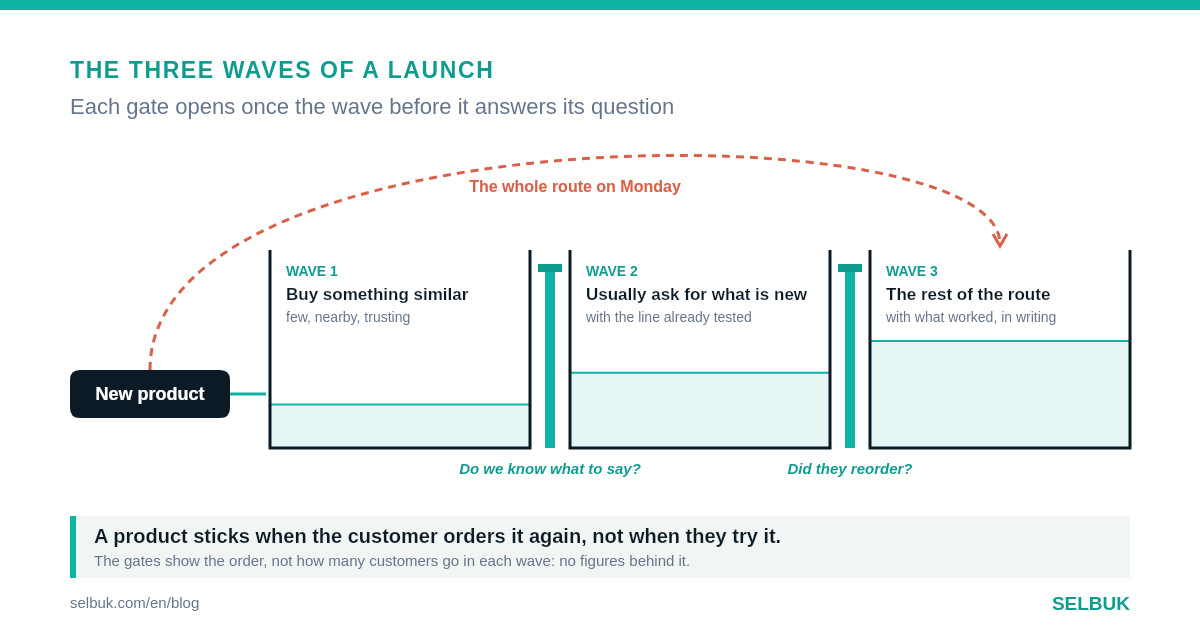
The first wave is not the biggest customers. It is the ones who already buy something similar, the ones who get along with the rep and the ones nearby, so the rep can come back soon. With them a mistake costs little, and they say honestly why they are not ordering, something a big, distant customer rarely does.
The second wave is the customers who usually ask for what is new, who can now be approached with a tested line. The third is the rest of the route, big accounts included, with what worked written down and shared. Between one wave and the next there is a question to answer, not a date on the calendar.
| The wave | Who it includes | What you need to know before moving on |
|---|---|---|
| First | Customers who already buy something similar, nearby and trusting | The line that makes the customer ask questions, and the objection that comes up most |
| Second | Customers who usually ask for what is new | Whether the first wave reordered, and which trial order gets repeated |
| Third | The rest of the route, the biggest accounts included | Which kind of customer keeps it, so you know where to push and where not to |
What to say on the visit
What works is almost never the spec sheet. What works is one line that connects the product to something that customer already does: "this is like what you order every week, but with..." To say it, the rep must walk in knowing what the account buys, what its own customers ask for and what it recently stopped ordering.
The trial order sits next to the usual one, small on purpose. The customer risks little with a few units next to what they already know, and the rep gets a concrete reason to come back: asking how they sold. A big order on the first visit is usually a favor to the rep, and favors do not repeat.
What to write down to correct course fast
What happens in the first wave only helps if it reaches the second. For each visit, write three things on the customer record: whether it was offered, what they said in their own words and whether they placed a trial order. Without that, the Friday meeting is just impressions, and every rep defends their own.
With those notes, after a week or two you can see what no spec sheet tells you: which objection keeps coming up, which line made the customer ask questions and which kind of customer ordered it. That is what goes into the second wave. If there is nothing to correct, probably not enough got written down.
| What usually gets done | Why it seems sensible | What gets lost |
|---|---|---|
| Starting with the biggest customers | That is where the most can be sold | The first impression of the accounts that matter most, with an untested pitch |
| Leaving samples and not coming back | If the product is good, it sells itself | The reason to come back, and what the customer really thought |
| Counting the customers who bought it | It is the number management asks for | How many reordered, which is what tells you it stuck |
| Giving everyone a launch discount | It lowers the barrier to try it | Knowing whether they order it for the product or for the price |
| Waiting until month-end to review | There will be more data to decide | Weeks of visits with a pitch that was not working |
The visit that decides is the second one
The first order says the customer was curious. The second says the product worked for them, that it sold or they used it, and that it has a place in their usual order. That is why the visit after the trial matters more than the pitch visit: it is when you ask how it went and adjust the quantity.
If the customer did not reorder, the visit still counts. Maybe it did not sell, maybe it sold and they forgot to order it, or maybe they put it where nobody could see it. Those are three different problems with three different fixes, and they only come apart by asking in the store, not by reading the report.
A product does not stick when the customer tries it. It sticks when they order it again without being offered.
What to try on Monday, without buying anything
- With the next product that comes in, before offering it, list the ten or fifteen customers for the first wave on a sheet, with the reason for each one.
- Write a single pitch line with the team and ask them to use it as is during the first week.
- Add three columns to the visit sheet: whether it was offered, what the customer said and whether there was a trial order.
- Put the follow-up visit for each first-wave customer on the calendar, one or two weeks after the trial order.
- Go back to the last launch: of the customers who ordered it once, count how many ordered it again. That is your starting point.
What has to be in place
For the next launch not to depend on each rep's instinct, three things have to be recorded. First, the list of customers in each wave, decided before heading out and with the reason for each one. That way nobody offers the product to the big account in the first week just because it was on the way.
Second, what each customer said on the visit, written on their record in their own words, so the second wave starts with what the first one taught. And third, the reorders of every customer who placed a trial order, visible by product, so you know which accounts it really got into and which ones only tried it.
With those three in place, a launch stops being a date when the product gets handed out and becomes a sequence of questions answered wave by wave. And the way you call it finished changes too: it does not end the day it has been offered to everyone, it ends the day it no longer needs to be offered.