What your top rep does differently, and how to copy it
Almost every team has one rep who sells more than the rest, and almost everyone has an explanation. A gift. Years with the same customers. Longer hours. All three have one thing…
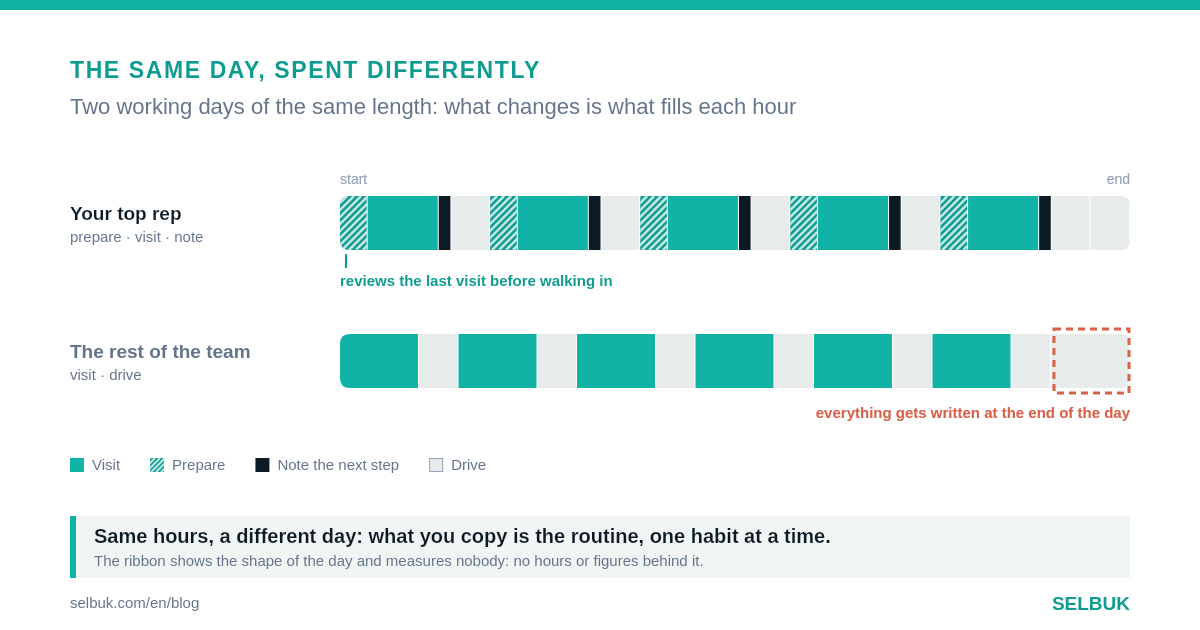
Almost every team has one rep who sells more than the rest, and almost everyone has an explanation. A gift. Years with the same customers. Longer hours. All three have one thing in common: none of them can be copied. And as long as it cannot be copied, what the best rep does stays with them.
The usual explanation copies nothing
The most common one is the hours, and it is almost always false. Just look at their week: they leave at the same time as everyone else, come back at the same time, and make a similar number of visits. Sometimes fewer. What changes is not how much they work, but where those hours go.
The "gift" does not help either. Saying someone has a good touch is a polite way of saying nobody bothered to look at what they actually do. And if nobody looks, the rest of the team can only imitate what shows from the outside: the tone, the confidence, the joke with the store manager. None of that transfers.
Results do not teach; behavior does
The month-end ranking says who sold the most, not how they did it. Rewarding results has its place, but it teaches nobody anything: the rep in fifth place knows they came fifth, and does not know what to do differently on Tuesday. For that, you have to go below the number to what happens on each visit.
The useful thing is to look for concrete behaviors: things the best rep does before, during or after a visit, that repeat, and that can be seen without asking them. If it shows in the records, it can be asked for. If it can be asked for, it can be checked on Friday. That is how talent turns into routine.
| What people say about them | What they are usually doing | Where it shows without asking |
|---|---|---|
| "They have a way with customers" | Walks in knowing what the account ordered last time and what it stopped ordering | The notes from the previous visit, opened before arriving |
| "They work harder than anyone" | Spends the same hours, but on different accounts | How many visits each customer got in the month |
| "Customers love them" | Leaves every visit with a date and a reason to come back | The next step written on the customer record |
| "They know how to sell" | Offers something the customer did not ask for on almost every visit | How many lines each order carries |
| "They got lucky with their territory" | Opens new customers in the same territory, a few at a time | New customers added in their territory, month by month |
Before copying, rule out luck
Not everything that sets the best rep apart is behavior. Sometimes they inherited the territory with the big accounts, or they sell the product line that moves fastest. Before asking the whole team to do the same, compare them with someone who has a similar territory. If the difference disappears, it was circumstance, not method.
Asking them to explain it does not work either. The best rep rarely knows what they do differently: they do it without thinking. It works better to sit down with a month of their records and ask about specific cases: why they went back to that account on Thursday, what they had prepared, what they noted on the way out.
How to copy it without asking for a talk
The top rep's talk in front of the team is the most common way to try this, and the one that works least. Everyone listens closely, everyone claps, and on Monday each one goes back to their own way of working. A list of ten best practices meets the same end: nobody changes ten habits at once.
What does work is picking a single behavior, the most visible and the easiest to check, and asking everyone for it for a few weeks. You check the behavior, not the sales: did everyone write down the next step on every visit. Sales take a while to move; the habit shows on the first Friday.
And before asking for it, it is worth understanding why the rest do not do it today. It is almost never laziness. Usually doing it costs more than it looks: finding the last visit's note in a notebook, remembering what they ordered three months ago, typing from the car. Remove that friction and the habit sets in on its own.
| The behavior | Why the rest do not do it today | What makes it easy |
|---|---|---|
| Reviewing the last visit before walking in | The note is in a notebook, or nowhere | The last note showing on the record when the customer is opened |
| Offering something they did not ask for | They do not remember what that account buys and what it does not | The purchase history, in view during the visit |
| Leaving a date and a reason to come back | It gets written "at the end of the day," and at the end of the day it is forgotten | A next-step field filled in before leaving |
| Opening one new customer a week | The week is already full of the usual visits | A slot reserved on the route, with a prospect's name on it |
You do not copy the top rep's talent: you copy their routine, one habit at a time.
What to try on Monday, without buying anything
- Pull last month's visits for your best rep and for one from the middle of the table with a similar territory. Put them side by side, without looking at sales.
- Find three differences that show in those records: visits per customer, what gets written down, how many lines each order carries. Drop the ones that depend on the territory.
- Sit with your best rep for half an hour and ask about five specific visits from that month. Write down what they did, not what they think.
- Pick just one of those differences and ask the whole team for it for three weeks. One, not three.
- Every Friday check whether it was done, not whether more was sold. If by the third week nobody is keeping it up, ask what makes it hard before asking for it again.
What has to be in place
For this not to depend on one person, three things have to be recorded. First, a note per visit with what happened and what was offered, kept on the customer record and not in the rep's memory. Without it there is no way to know what anyone does differently, neither the best nor the last.
Second, each account's next step as a dated field, not as an intention. And third, the history of what each customer buys, in view during the visit, which is what makes it possible to offer something that makes sense instead of reciting the catalog.
With those three in place, what the best rep does stops being a mystery and becomes something you can look at, ask for and check. The team will not sell exactly like them, but it will work more like them. And the day the best rep leaves, what they did stays.