Saturated or empty territory: how many businesses in your area have never had a visit
Some reps visit the same thirty customers every week and have never walked into the business on the next corner. Their territory looks well worked: plenty of visits, steady…
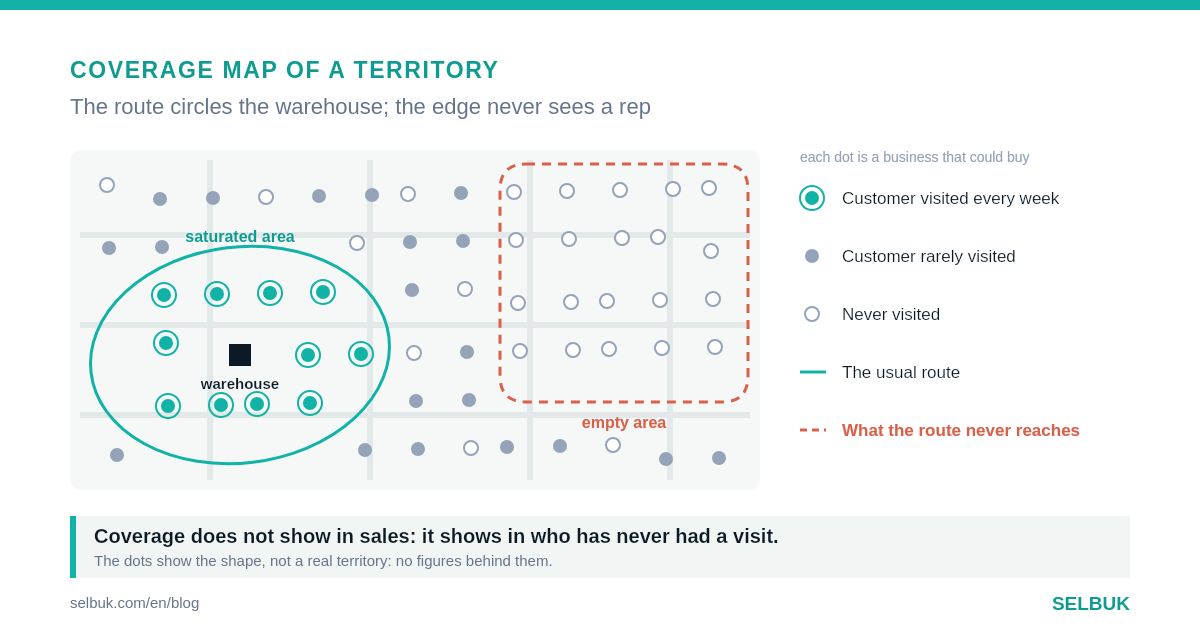
Some reps visit the same thirty customers every week and have never walked into the business on the next corner. Their territory looks well worked: plenty of visits, steady orders, good relationships. But the map has whole streets where nobody from the company has ever set foot, and that is where the sales the report does not show are sitting.
Two territories that look the same in the report
A saturated territory is one that gets too many visits: the same customer seen three times in a week when once would have been enough. An empty territory is one that gets none: businesses that could buy and have never seen a rep. Very often both things happen inside the same territory.
The sales report cannot tell them apart. Both add visits and orders to the same rep, and if the monthly total looks fine, nobody asks where it came from. The rep hits the number, the territory looks covered and the sales manager moves on. What is not bought in the empty part never shows up as a loss.
What coverage is and how to measure it
Coverage is a simple division: out of all the businesses in the territory that could buy from you, how many you actually visit. You already have the top number, because those are your customers and your visits. Almost nobody has the bottom one, because it means looking at the whole territory. Without it, coverage cannot be measured.
Suppose a territory has eighty businesses that could buy the product. The account list has thirty, and twenty-five of them are visited every week. The other fifty have never had a visit. With these made-up numbers, the rep is busy all week long and still has never met more than half of the territory.
| The question about the territory | What answers it | What usually shows up the first time |
|---|---|---|
| How many businesses here could buy from me? | A list made by driving the territory, not just the account list | That the list is quite a bit longer than the account list |
| How many of them are already customers? | The account list matched against that list | That the accounts are bunched on a few streets |
| How many are actually visited? | The logged visits from the last month | That a few customers take almost all the visits |
| How many have never had a visit? | The list minus customers and prospects already contacted | Whole streets with no contact at all |
| Where do the visits cluster? | The visits plotted on a map | That the route circles the same spot |
Why a territory saturates on its own
Nobody decides to saturate a territory. It happens out of comfort. The rep goes back where they are welcome, where they already know what to order and whom to ask. Walking into a new business costs something: they do not know you, they make you wait and they often say no. Visiting the usual customer again costs nothing.
Distance pushes the same way. The route gets built around the warehouse or the rep's home, and whatever is far away waits for a day with spare time, which never comes. And if sales are short at the end of the month, the rep looks for them where they know they will find them: with the customer who already buys.
Each of those decisions makes sense on its own. Together they produce a territory with an over-visited center and edges nobody touches. And when the sales manager asks why no new accounts are opening, the rep has answers that sound reasonable and that almost never get checked.
| If the rep says... | What may be true | How to check it in an afternoon |
|---|---|---|
| "There is nothing in that area" | That they have not been there in months | Drive it once and count the businesses that could buy |
| "My customers need me to come often" | That some do, and others just enjoy the visit | See whether the order changes when visits are spaced out |
| "I do not have the time" | That the time goes into the center of the territory | Put one week of visits on a map |
| "I already went and they said no" | That it was once, a long time ago, with a different offer | Look up the date and the note from that visit |
| "Those are not customers for us" | That sometimes it is true, and it helps to know why | Write the reason next to each one that gets ruled out |
None of those lines is a lie. They are the honest explanation of a habit. Without the map in front of you, nobody can argue with them. With the map, the conversation changes: it is no longer about whether the rep works hard, but about where the week goes and which part of the territory stays untouched.
A territory is not covered because the rep is busy. It is covered when you know who they have never visited.
What to try on Monday, without buying anything
- Pick one territory and list the businesses that could buy by driving it once, not by copying the account list.
- Mark on that list who is a customer, who has been visited at some point and who never has. Just counting changes the conversation.
- Put the last week of visits for that territory's rep on a map and see where they cluster.
- Give the rep five businesses that have never been visited and ask for a first visit to each one this month.
- For every customer who gets several visits a week today, ask what would happen if they got only one.
What you need to have in place
Measuring coverage takes three things in plain sight. First, the full list of businesses in each territory that could buy, both customers and non-customers. That list does not come out of the sales system: it comes from driving the territory, and it needs a review every so often because businesses open and close.
Second, visits with their location, so you can see on the map where the week goes. And third, a mark on each business that says when the last visit was, or that there never was one. With those three things, the conversation with the rep stops being about impressions and becomes about specific streets.
With that, the territory is no longer measured by what it sells but by what it has not touched yet. The rep keeps serving their customers, with part of the week set aside for the edges. And the territory map stops being a map of the customers you have and becomes a map of the ones you are missing.