The new customer who never places a second order
A new customer's first order gets celebrated. It goes in the report, it comes up at the meeting, and the rep moves on to the next prospect. What almost nobody checks is whether…
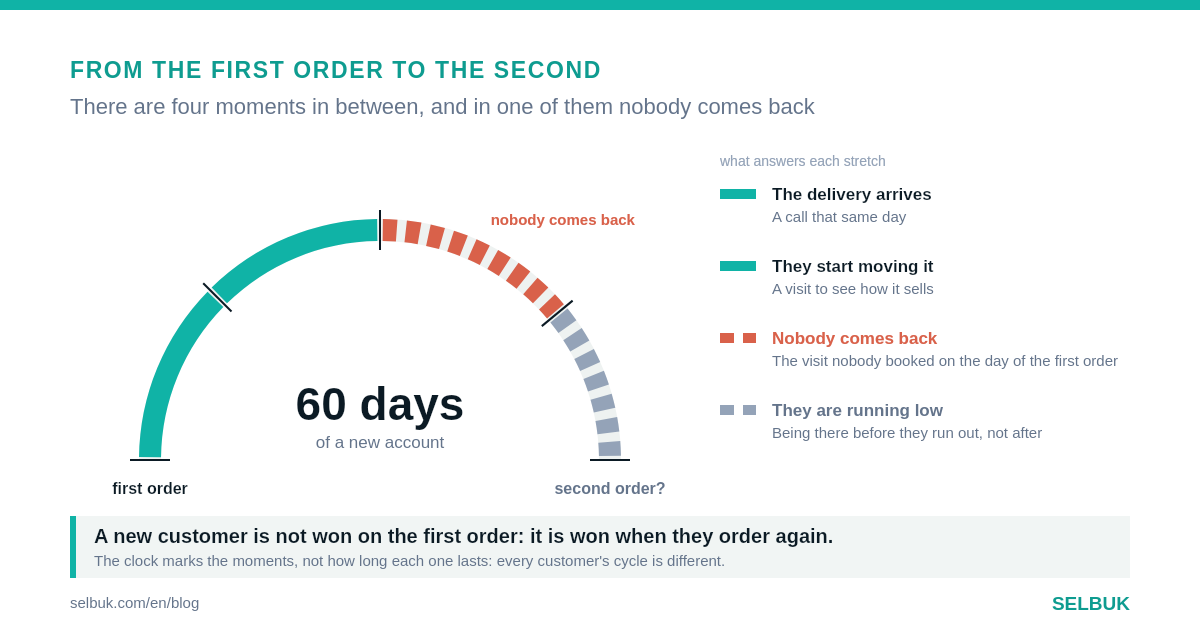
A new customer's first order gets celebrated. It goes in the report, it comes up at the meeting, and the rep moves on to the next prospect. What almost nobody checks is whether that customer ordered again. And many new accounts stop right there: one order, one invoice, then silence, and nobody notices.
Why the second order is worth more than the first
The first order is a trial. The customer buys to see how it goes: whether the product sells, whether delivery is on time, whether the rep answers when something fails. They have not decided to work with you yet. They have decided to try, and trying is cheap for them: if it fails, they never call again.
The second order is the decision. It is the moment the customer says, without saying it, that the first time worked for them. From there the account has a cycle, a product mix and a relationship. Before that there is only a one-off sale, and a one-off sale does not count as a book of business.
That is why a new customer deserves a different look. Getting the first order took visits, samples and time spent negotiating. If the account never reaches the second, all that effort ends up as a single invoice. And it is rarely because the customer was unhappy: it is because nobody came back when it mattered.
What happens in the first 60 days
Suppose the normal buying cycle for that kind of customer is one month. The first 60 days hold the delivery, the first use, the moment they run out of what they bought and the decision to order again. Each of those moments comes with a question in the customer's head.
| The moment | What the customer is asking themselves | What answers it |
|---|---|---|
| The delivery arrives | Did I get what I ordered, complete and on time? | A short call that same day to confirm it |
| They start selling or using it | Does this move, or am I stuck with dead stock? | A visit to see where it is placed and how it is moving |
| Something goes wrong | Will they answer, or did they get paid and forget me? | The problem gets solved before the next purchase |
| They are running low | Do I order it again, or try someone else? | Being there before they run out, not after |
| They place the second order | Should I order more, or the same? | Fitting the order to what actually moved |
None of those moments calls for a pitch. They call for presence. The rep who won the first order is usually chasing the next prospect right when the new customer has the most important doubt: whether this relationship is going to work. And an unanswered doubt at that stage settles itself, almost always by buying from someone else.
Why it slips away without anyone seeing
A new account does not warn you when it leaves. No complaint, no return, no call. It just never orders again. And since the sales report counts orders, not missing orders, the account that never came back shows up nowhere. It disappears in the same silence it arrived in.
Add to that how reps get rewarded. If what gets celebrated is the new customer, the incentive is to open accounts, not to settle them. Going back to an account that already bought feels like maintenance work, less exciting than landing another one. But an account that orders twice is worth more than two accounts that ordered once.
| What gets measured today | What it hides | What you should look at |
|---|---|---|
| New customers this month | How many of them never came back | New customers who reached a second order |
| Rep's total sales | Whether it comes from accounts that stay or from one-off first purchases | What share comes from accounts with more than one order |
| Visits per week | Whether any went to a new account after its first order | Visits to new accounts within their first 60 days |
| Size of the first order | That a big first order sometimes leaves stock sitting on the shelf | Whether the first order moved before the next visit |
| Active accounts | That an account with a single order counts the same as one with years | How many active accounts have a single order |
None of those measures is hard to pull. The problem is that nobody asks for it. When the sales manager starts asking at the meeting how many new customers reached a second order, the team starts going back to those accounts. What gets asked every week is what gets done.
A new customer is not won on the day of the first order. It is won on the day they order again.
What to try on Monday, without buying anything
- Pull the list of new customers from the last three months and mark which ones placed a second order. Just that: see the number.
- Call the ones who did not come back yourself, not the rep. Ask what happened with the first order and listen without getting defensive.
- Ask that every new customer get a call on the day their delivery arrives. Two minutes: confirm it arrived fine.
- Book a visit for each new account before they run out of what they bought, even if no order is due.
- At the Friday meeting, ask about the new customers who reached a second order, not just the ones that were opened.
What has to be in place
For a new customer to reach a second order, three things have to be in plain sight. First, the date of each new account's first order, so you know which day of its first 60 it is on. Without that date, the new account blends in with the rest and nobody knows it needs different attention.
Second, a follow-up visit booked on the same day as the first order, before the rep moves on to something else. And third, a short list of accounts with a single order, reviewed every week, to see which ones are going quiet before the silence becomes permanent.
With that, a new customer stops being a number that gets celebrated one day and forgotten the next. It becomes an account on its way in, with dates and someone keeping track. And the monthly count changes its question: not how many customers were opened, but how many stayed.