The follow-up nobody does: how many visits it actually takes
The customer who didn't buy almost never said no. They said "let me look at it", "come back next week", "I have no shelf space right now". That isn't a rejection: it's a date…
The customer who didn't buy almost never said no. They said "let me look at it", "come back next week", "I have no shelf space right now". That isn't a rejection: it's a date nobody wrote down. And the date gets lost between the next stop and the twelve behind it.
What kills the sale isn't the objection. It's the silence that comes after it. The rep leaves with every honest intention of circling back, and by Thursday there are twenty other customers on top of it and nothing anywhere to flag which one was left half finished.
Nobody decides to abandon a sale
Ask a rep how many times they pushed before writing a customer off. They don't know. Not because they're lying: because nobody ever counted. Abandonment isn't a decision someone makes and records somewhere. It's what's left over when follow-up depends on remembering.
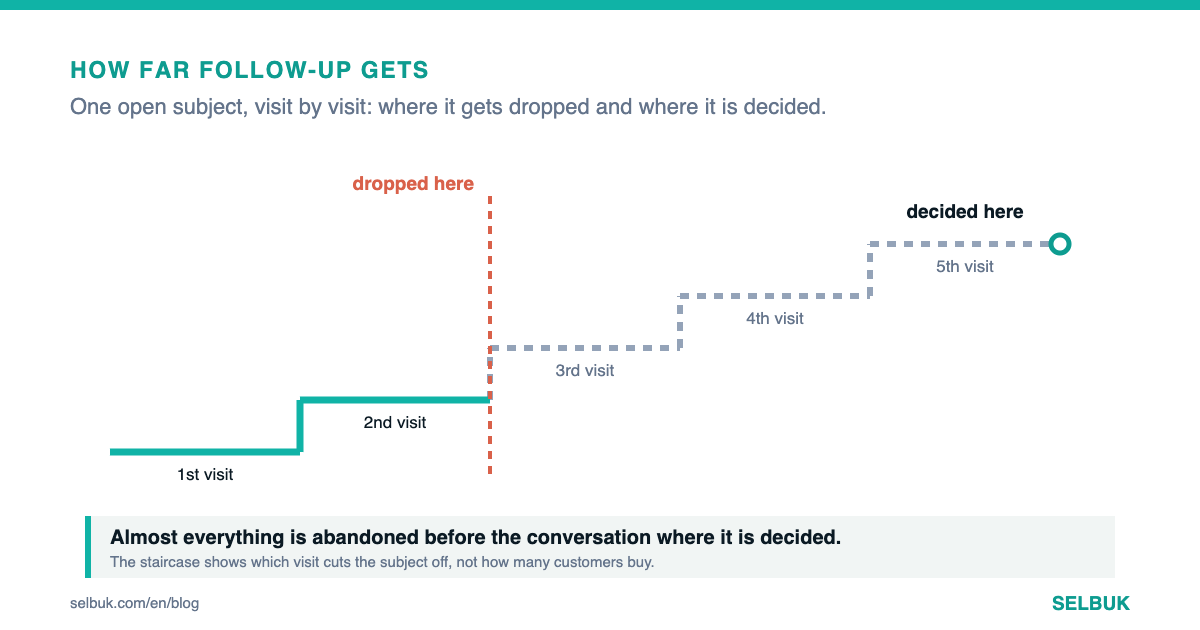
That's why the number matters. A team that drops the subject on the second conversation and one that carries it to the fifth sell differently with the same product, the same price and the same route. The difference isn't out on the street: it's in how many rounds the subject survives.
Almost everything gets abandoned before the conversation where it's decided. The rep never gets as far as hearing the no; they get as far as being worn down by the "not yet". Those are two different things, and the second one is fixable without touching product or price.
The arithmetic that explains it
Suppose a rep with twelve visits a day and five days on the route: sixty visits a week. In twenty of them something is left open —a product the customer wants to think about, a price they have to check, shelf space they need to clear before taking it in.
Using our own numbers: if the rep comes back on twelve of those twenty and the other eight never get past a single mention, the following week starts with eight conversations that will never finish. They didn't fall on price. They fell for want of a second round.
The uncomfortable part is that those eight show up in no report. They aren't rejected orders or inactive customers: the customer kept buying the usual. They're subjects that went cold without leaving a trace, and at month end they read as "the market is slow".
Where the team drops off
Laid out in order, an open subject follows a fairly similar path in almost any book of business. What changes from one team to another is where it gets cut.
| The visit | What usually happens | What the team that comes back does |
|---|---|---|
| First | The product or the condition gets mentioned. The customer listens and asks for time. | What was mentioned and what the customer said is written down, in their words. |
| Second | The rep brings it up again if they remember. This is where most of it dies. | Walks in already seeing the open subject, before saying hello. |
| Third | The subject isn't raised anymore. The customer assumes it wasn't important. | Brings an answer to that specific objection, not the whole pitch again. |
| Fourth | Nobody remembers there was a subject. The conversation is only the usual order. | Changes the angle: one trial unit, a smaller assortment, a different date. |
| Fifth and beyond | Rarely reached. It's where the customer really says yes or no. | Arrives with the four earlier conversations in view, and closes or drops it. |
The row that hurts most is the second one. Not because the customer shuts the door there, but because that's where coming back costs the least and the subject still gets dropped. The visit is already paid for and the rep is already inside.
Follow-up can't live in the rep's memory
A rep with eighty active customers can't hold eighty open threads in their head. Nobody can. And when the follow-up system is memory, what survives isn't the most important thing: it's the most recent and the loudest.
So the team that comes back isn't the one with the better memory. It's the one that reaches the stop with the previous subject already in front of them, with nothing to look up. The operational difference is thirty seconds before getting out of the vehicle, and it's worth several orders a month.
A customer isn't lost when they say no. They're lost the day nobody raises the subject again.
And there's a hidden benefit: once the open subject is recorded, the no becomes useful too. A "the large format doesn't work for me" written down today saves three wasted visits next month and opens the door to offering the small one.
What to test on Monday, without buying anything
Five tests you can run with what you already have, whether that's a spreadsheet, a notebook or whatever system you use today.
- Count last week's open subjects. Ask each rep for the list of customers who said "I'll think about it". If there's no list, that's the finding.
- See how many got a second mention. Not a second visit: a second time the same subject was discussed. It's usually fewer than half.
- Ask at which visit they give up. If the team's answer is "it depends", there is no follow-up: there are scattered attempts.
- Review three customers written off. Look for whether anyone recorded the reason. If the reason isn't there, the customer isn't lost: they're unfinished.
- Run the cold Monday test. Pick a route and ask the rep to say, before leaving, what open subject is waiting at stop three. If they have to call the office, you know what's missing.
What has to be in place
Making this work doesn't take a new process. It takes three things being recorded during the visit and visible on the next one, without anyone hunting for them.
| What gets recorded | Where it usually lives today | What question it answers on Monday |
|---|---|---|
| The subject left open | In the rep's head | What do we need to talk about at this stop? |
| The customer's own words | In a chat, buried in messages | Which objection has to be answered, exactly? |
| How many times it came up | Nowhere | Do we push again or drop it? |
| The date the customer asked for | On a loose note | Is this the right visit, or am I early? |
With that in place, follow-up stops being a virtue of the rep and becomes a routine of the team. Whoever is good at remembering is still good at it; everyone else stops losing orders for failing to remember.
And one measure is missing from the report: next to the day's visits, how many of them carried an open subject from the time before.