Not every customer deserves the same visit: how to spend the week by potential
Tomorrow's route built itself. The rep opened the map, saw which customers sat close to each other, and ordered the week by city blocks. Nobody decided anything: geography…
Tomorrow's route built itself. The rep opened the map, saw which customers sat close to each other, and ordered the week by city blocks. Nobody decided anything: geography decided. And geography has no idea which of those accounts could double its order this quarter.
A route is built with a map, not with a decision
Building by proximity is reasonable: it saves miles and it saves hours. The problem is that saving miles is not what the sales team is for. The team is there to sell more. When distance is the only criterion, every account in the same zone gets the same attention, whether or not they are worth the same.
And something worse happens. The big account and the small account on the same street each end up with one visit, of the same length, with the same preparation. The rep walks out of both with the same sense of a job done. Friday's report does not tell them apart either.
What they bought is not what they can buy
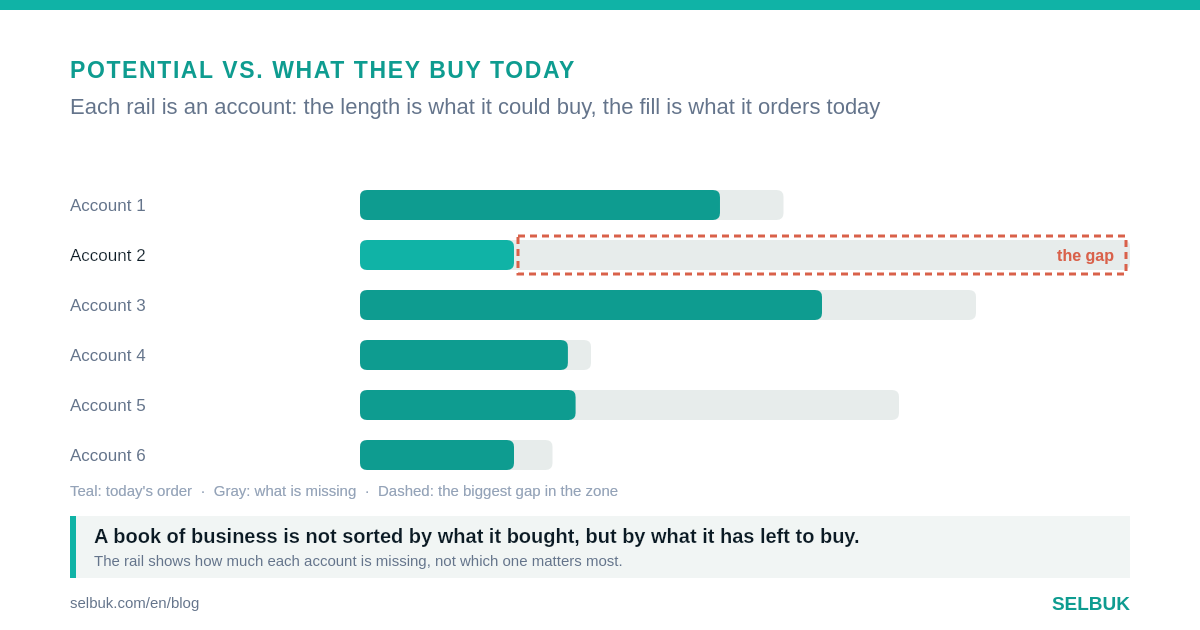
Almost every book of business is sorted by last year's sales. It is the number that exists, it is easy to pull, and it looks fair. But it measures the past. A customer who bought little may have bought little because nobody ever offered them half the catalog, not because they cannot buy more.
Potential is a different thing: how much that account could buy if it were served well. It is not a field in the system, it is the rep's estimate, built from three simple questions. How big is the business. How many of our product families could it move. And how much is it buying today from someone else.
The third one is the most uncomfortable and the most valuable. A customer who buys 300 a month and moves 3,000 in your category is not a small customer: it is a big customer being served badly. On a list sorted by sales it shows up at the bottom, mixed in with the ones that really are small.
Four kinds of account in the same book
Crossing what an account buys today with what it could buy leaves four groups. No model and no consultant required: with the rep's own judgment and half an hour per zone, a whole book gets classified. What matters is that each group gets a different kind of visit, instead of the same visit as always.
| The kind of account | How it looks in the report today | The visit it deserves |
|---|---|---|
| Buys a lot and could still buy more | Top of the list, untouchable | Frequent, prepared visit, with the catalog they never ordered on the table |
| Buys little and could buy a lot | Bottom, mixed in with the small accounts | The visit you have to invent: more often, with something new every time |
| Buys a lot and is already at its ceiling | Top of the list, "the star account" | Short service visit: keep it from slipping, but stop asking it to grow |
| Buys little and cannot buy more | Bottom, same as the second one | Spaced-out visits, or phone and remote ordering |
The group that changes the quarter is the second one. It is the only one where extra effort has somewhere to go. In the other three the visit holds steady or gets trimmed, but there is nothing to grow: either you are already taking everything there is, or there is nothing more to take.
The same effort, spent differently
Suppose a rep with sixty visits a week, twelve a day, and a book of one hundred twenty accounts. Split by proximity, every account gets one visit every two weeks, all of them alike. It is a comfortable split to explain, and it forces nobody to decide anything.
Now the same number of visits, split by potential. The fifteen accounts in the second group move to weekly: fifteen visits. The twenty in the first, every two weeks: ten. The thirty-five in the third, once a month: nine. The remaining fifty, every six weeks: eight. That adds up to forty-two.
Eighteen visits a week are left over. And they are not slack: they are the budget that used to be spent dropping in every two weeks on accounts that did not need it. They go into second passes at the second group, and into new customers in the zone. Mileage goes up a little; the book stops being flat.
| The decision | Split by proximity | Split by potential |
|---|---|---|
| How often the badly served big account is seen | Every two weeks, like everyone | Every week, with the order prepared |
| How often the account at its ceiling is seen | Every two weeks, like everyone | Once a month, or by phone |
| What gets prepared before walking in | The customer list for the zone | The families that account never ordered |
| How many visits are free for new customers | None: the week is full | The ones freed by the group that got spaced out |
| What gets looked at on Friday | Visits completed | Visits completed in each group |
An account that buys little and could buy a lot is not a small customer: it is a big customer you do not yet know how to serve.
What to try on Monday, without buying anything
- Take the twenty accounts in a single zone and write next to each one, by hand, how much you think it could buy a month if everything went well. With the rep in the room, in half an hour.
- Sort that list by the gap between what it buys and what it could buy, not by sales. The order changes, and the top three are almost always a surprise.
- Mark the top five and give each of them an extra visit this week. Take it away from the bottom five, which is the part that hurts.
- Before walking into each of those five, write down the product families that account has never ordered. That is the whole preparation.
- On Friday compare the five that got the extra visit with the five that lost one. If nothing happened in any of the ten, what was wrong was the classification, not the method.
What has to be in place
For this not to end up as one afternoon of good intentions, three things have to be recorded. First, a potential estimate per account, even if it is a number the rep put down by eye and reviews each quarter. Without that field, the book goes back to being sorted by sales the next day.
Second, visit frequency as a field on the customer record, not as a habit in the rep's head. And third, the history of which families each account has bought, which is what turns a prepared visit into something other than a friendly one.
With those three in place, the route stops being a map problem and becomes a budget decision: you have sixty visits a week and they have to be spent on somebody. Monday's conversation with the rep is no longer how many customers they saw, but who they decided to spend the week on, and why.