The second line on the order: selling more on the visit you are already making
The cost of a visit is paid before anyone knows what will be sold inside it. The fuel, the rep's time, the wait at the counter and the walk back to the truck cost the same whether…
The cost of a visit is paid before anyone knows what will be sold inside it. The fuel, the rep's time, the wait at the counter and the walk back to the truck cost the same whether the customer orders one line or six. That asymmetry is the one almost nobody uses.
Which is why the conversation about selling more usually starts on the expensive side: more visits, more reps, longer routes. And the margin that is easiest to reach sits on the other side, inside the order being written right now, with the customer standing there and the door already open.
The one-line order
Most field orders are taken by dictation. The customer says what he is out of, the rep writes it down, gets a signature and leaves. It is fast, it is comfortable for both of them, and it leaves out everything the customer would have bought if someone had named it out loud.
This is not laziness on the rep's part: he walks in with no information. He does not know what that account bought two months ago, what it stopped ordering, or what similar businesses on the same block are buying. Without that, all he can do is write down dictation.
What the customer used to buy and did not order today
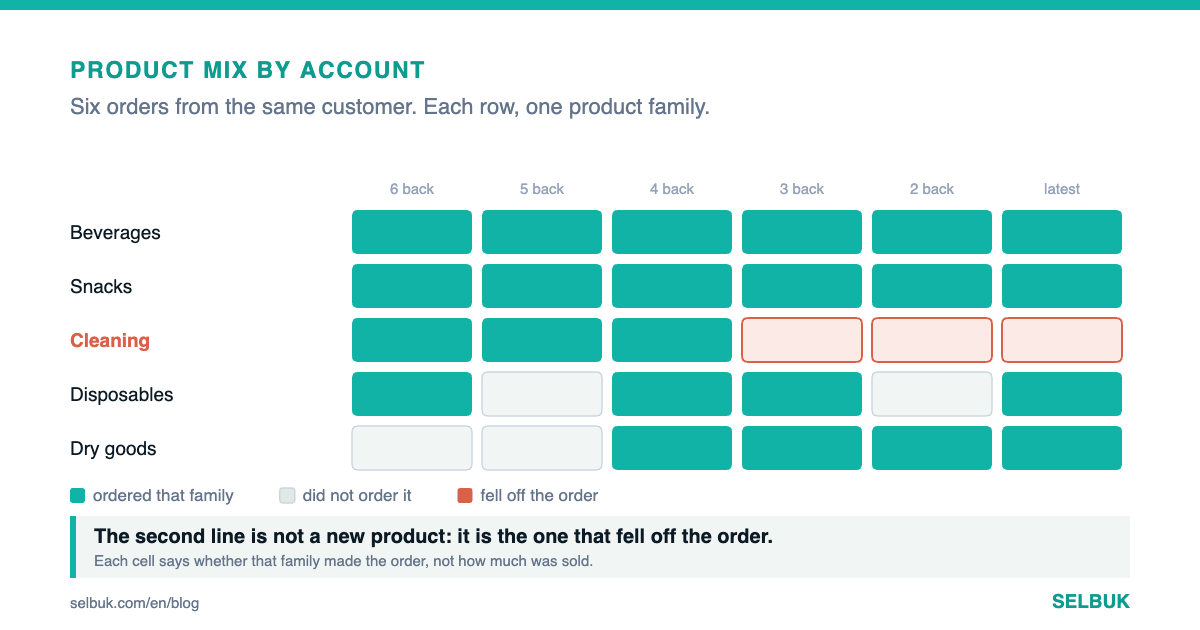
The second line is almost never a new product. It is something that account already bought, already sold and already knows how to handle, and that dropped out of the order without anyone noticing. Putting it back is the easiest sale there is, and it only takes reading the history before walking in.
| The signal | What it actually means | What to do on this visit |
|---|---|---|
| A whole product family vanished three orders ago | He is either buying it elsewhere or he ran out of shelf space | Ask about that family by name, not about the whole catalog |
| He orders exactly the same thing every time | The order is taken from memory and nobody has offered him anything next to it | Read the previous order back to him and propose one single addition |
| He buys the small pack of something that moves fast | He is restocking by hand every week and has never thought about it | Offer the larger pack with the per-unit math already done |
| He has never bought the main family for his type of business | That is a gap in what was offered, not a decision he made | Show two specific items, never the entire list |
| Part of the last order was never delivered | There is a sale he already agreed to that is still sitting undelivered | Close it inside today's order, before talking about anything new |
Why a wider order beats a longer route
The math is worth doing with your own numbers and nobody else's. Say a route of twelve visits a day and an average order of four lines: the day closes at forty-eight lines. If the team wins one extra line on one visit out of every three, the day closes at fifty-two instead.
That is four more lines with no extra mile, no extra hour and nobody new on payroll. The thirteenth visit, by contrast, costs the drive, the wait and the risk of running late on everything after it; and it is usually the account that landed at the bottom of the list precisely because it buys so little.
None of this means the route does not matter. It means that widening the route and widening the order do not cost the same, and that most teams push the expensive one first because it is the one you can see.
The most profitable visit of the day is the one you are already making.
How the second line gets prepared before you knock
A second line improvised at the counter sounds improvised, and it gets turned down. Prepared, it is a ten-second sentence that comes straight out of that account's history. The difference is not the rep's script: it is what he has in hand when he steps off the truck.
| What to check before walking in | Where it lives | The sentence it produces |
|---|---|---|
| The account's last three orders | The history on the customer record | "You took this last time and didn't order it today — want me to restock it?" |
| What similar businesses nearby are buying | The customer list grouped by type of business | "Shops like yours are moving this right now" |
| What was left open on the previous visit | The visit note, not somebody's memory | "We agreed I'd bring you the price on this" |
| The undelivered balance | Orders flagged as partially delivered | "You're still owed six — should I add them to this order?" |
| Today's live promotion | The day's catalog, with its cutoff date | "This week the large pack is almost the price of the medium one" |
What to try on Monday, without buying anything
- Pull last month's orders and count the lines on each one. If half of them have one or two lines, that is where the margin is — not in the route.
- Pick ten accounts and compare this week's order against the one from three months ago. Mark in red every family that disappeared with no explanation.
- Ask each rep to arrive at three of the day's visits with a second line already decided and written down before leaving. Three, not twelve.
- At the end of the week, ask how many of those thirds said yes. It is the only number that tells you whether the method works.
- Compare lines per order for your top seller against the team average. The gap is almost always there, and not in the number of visits.
What has to be set up
For this to stop depending on each rep's memory, four things have to be on record: the account history visible out in the field and not back at the office, the note on what was left open, the undelivered balances from earlier orders, and the customer list grouped by type of business.
And one more column in the report: lines per order, sitting next to the amount. A team measured only on total billed will never know whether it is growing because it sells better or because it drives more. Those are two different businesses, and they cost very different money.