A new rep's first day: what to check before asking how much they sold
A new rep's first day almost always looks the same: a customer list, a quick run-through of the product, good luck, see you Friday. It is the day that generates the least data and…
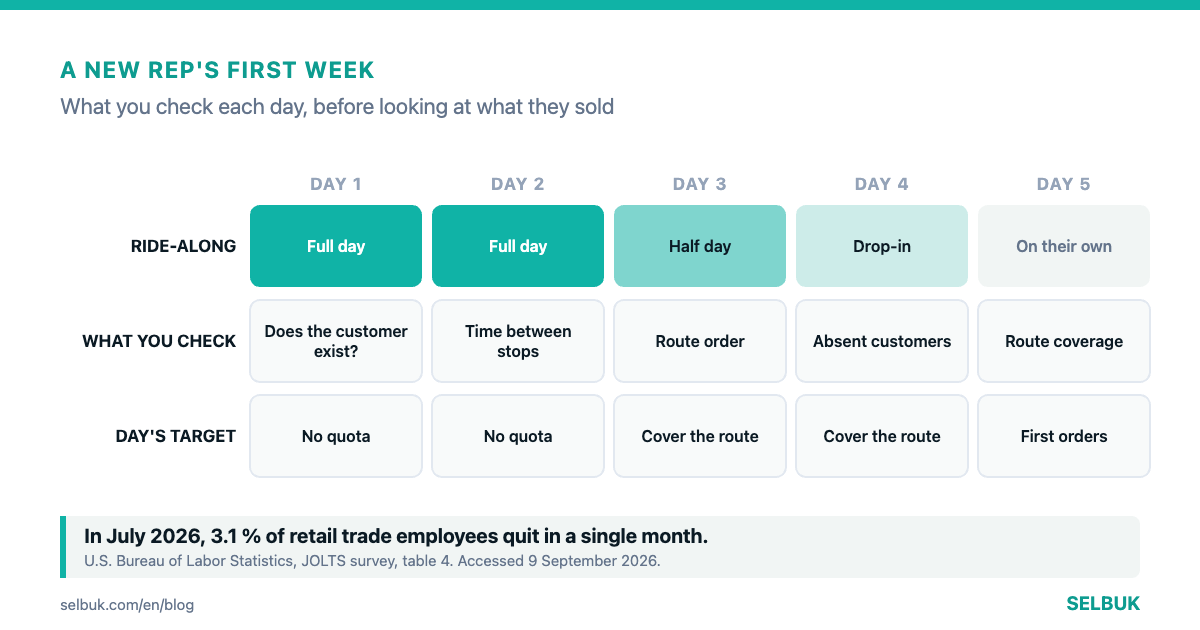
A new rep's first day almost always looks the same: a customer list, a quick run-through of the product, good luck, see you Friday. It is the day that generates the least data and decides the most about whether that person lasts three months or three years.
The first day's sales number tells you nothing. Almost nobody sells on day one. Everything else tells you plenty: how many doors they reached, in what order, how long they spent between stops, and what they did when the customer wasn't there. All of it is visible the same day, and fixable the next.
Why the first day carries so much weight in the field
Turnover in trade is measured, not guessed. In July 2026, 3.1 % of retail trade employees quit in a single month, against 1.9 % in wholesale trade and 2.1 % across the private sector, per table 4 of the JOLTS survey from the U.S. Bureau of Labor Statistics (accessed 9 September 2026).
Tenure points the same way. In January 2024, half of all retail trade workers had been with their employer 2.9 years or less, against 4.6 years in wholesale and 3.9 across the economy, per table 5 of the same agency's tenure report (accessed 9 September 2026).
For a field team that translates easily: the door spins fast and every spin costs. It costs the route nobody covers, the customers who meet a different stranger every quarter, and the supervisor weeks spent teaching the same thing again.
What you check on day one, and it isn't the sale
Whether the route actually existed
The list handed to a new rep usually comes from the database, not from the street. Customers who closed a year ago are still on it. By the end of day one you should know how many of those addresses were an open business. If one in five fails, the list is the problem.
How long each hop took
Travel time between stops is the most honest signal of the first day. If the route sends them across town twice, the clock says so before the rep does — they don't yet know that isn't normal, so they won't complain. A veteran would have quietly resequenced the stops and told nobody.
What they did when nobody was in
Half the visits on day one end with no one to talk to. That is where judgment shows: whether they logged the attempt, asked what time the manager is around, came back later, or simply drove on. This gets taught on the first day or it never gets taught.
What they asked when they got back
A new rep who comes back with no questions is a warning sign, not a sign of independence. It means they never talked to anyone long enough to hit a strange price, a pending return or an angry customer. All three are on every route.
What gets reviewed, and when
| Point | What you look at | What you don't look at yet |
|---|---|---|
| Day one | Stops reached, dead addresses, time between visits, what they did with an absent customer | Revenue |
| First week | Whether the route order holds, repeat customers, first orders taken | Quota attainment |
| First month | Coverage of the full route, orders per visit, reactivated customers | Comparison with veterans |
| Third month | Quota, receivables, sustained visit frequency | — |
Ride-alongs: what the supervisor does in the truck
Riding along on day one is not selling for them or correcting them in front of the customer. It is sitting in the passenger seat and staying quiet. Whoever rides along is watching two separate things: how the rep presents, and how the route behaves. The second rarely gets written down, and it repeats with everyone who comes after.
A useful ride-along ends with two lists: what the person has to improve and what the company has to fix. If everything lands on the first list, the ride-along was done badly. No new route is perfect.
Support tapers, it doesn't stop dead: a full day at first, half a day on the third, then unannounced drop-ins. Cutting them loose on day two saves one supervisor day and costs two weeks of a disordered route.
The starting quota: the first target isn't a sales target
Handing a revenue quota to someone who doesn't yet know where half their customers are teaches exactly one thing: that the quota is decorative. The first target should be coverage — visit every stop on the route at least once — and only later an amount.
A realistic starting quota is built from what the previous rep did on that same route, not from the team average. If nobody ran it before because the route is new, then the first month is for measuring it, not for demanding it. A number with no basis turns the first review into an argument about the number.
When the signal points at the route, not the person
| What you see on day one | What it usually means | What to do |
|---|---|---|
| Fewer than half the stops reached | The route has too many visits, or they are badly ordered | Trim and resequence before day two |
| Several addresses with no business | The database hasn't been cleaned in a long time | Mark the customer closed the same day, not at month end |
| Long, uneven travel times | The route was built alphabetically or by customer age, not by geography | Rebuild it by zone |
| Many customers out at the same hour | The time window doesn't match how that kind of business operates | Move those visits to another hour, not to another rep |
| No questions at the end of the day | There was little real conversation with customers | Ride along one more day before cutting them loose |
What they get before they leave
Little, and concrete: the day's route already in order, the current price of what they will offer, the list of who owes the company money, and what to do if someone pays cash. Everything else — full catalogue, history, discount policy — is learned with the route already moving.
What they don't get on day one is responsibility for collections with no procedure explained. A new rep carrying someone else's money with no instructions is the company's problem, not theirs.
The uncomfortable conclusion
Almost everything you learn on day one is information about the company, not about the rep: dead addresses, badly built routes, wrong hours, procedures nobody wrote down. They are simply the first person in years to walk that route with fresh eyes.
Which is why the first day is worth recording instead of letting it pass. With visits, hours and outcomes logged — in a field tool like SELBUK or in a tidy notebook — the next new rep starts on a route the last one already corrected. With no record, each of them trips over the same things.