A route app gets you to the door; a field CRM knows what happened inside
A manager who wants to get the street under control almost always starts with the same search: an app that optimizes the day's route. It is a good tool and it does its job well…
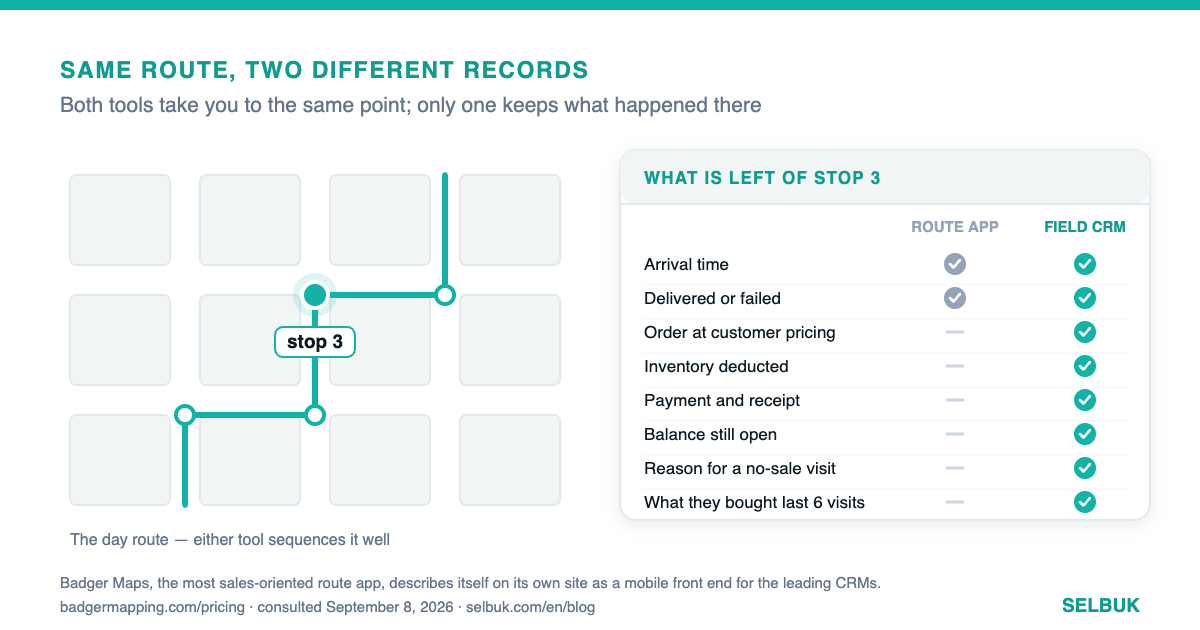
A manager who wants to get the street under control almost always starts with the same search: an app that optimizes the day's route. It is a good tool and it does its job well. The trouble shows up later, when somebody asks what happened at stop number seven and the map has no answer.
The two tools do not solve the same problem
A route app solves the travel: what order to visit in, which way to go and what time you arrive. A field CRM solves the stop: what was sold, at what price, what left the inventory, how much was collected and what is still owed.
Both jobs matter. The confusion gets expensive when you buy one expecting it to do the other: the route comes out spotless and the result of the visit still lives in a notebook, in a WhatsApp thread, or in the rep's head.
What a route app does better than anyone
If the day's work is delivering things that were already decided, a route optimizer wins with no argument. OptimoRoute plans up to 700 orders in one pass on its Lite plan and 1,000 on Pro, with live ETA, real-time tracking and proof of delivery on the higher tiers.
Spoke Dispatch, the product formerly known as Circuit for Teams, charges per stop instead of per person: 125 dollars a month with 1,000 stops included and 4 cents for each extra stop. For a courier with high volume and a changing crew, that model makes complete sense.
A CRM does none of that better. Notifying the recipient, calculating the arrival window, capturing a delivery photo and resequencing a hundred stops in seconds is what these tools are for. If your operation is pure delivery, that is the correct purchase and there is nothing else to debate.
Where it breaks: the stop that decides something
The difference is not on the map, it is in what happens when the rep steps out of the truck. There are two kinds of stop. In one, you hand over something already decided. In the other, it gets decided right there: which product, how many, at what price, and whether it is paid today or goes on credit.
A route app has nowhere to store the second kind. Its unit of work is the stop, and a stop ends in "delivered" or "failed". It does not carry customer-specific pricing, or balances, or stock on hand, or receipts. That is not a flaw in the product: it simply is not the problem it was built for.
There is a clear signal about where the boundary sits. Badger Maps, the most sales-oriented route app on the market, describes itself on its own pricing page as a mobile front end for the leading CRMs. In other words: it assumes the CRM already exists and that it is not replacing it.
What a field CRM records during that same visit
The list is short and entirely operational. These are not pretty reports: they are the data without which the visit cannot be audited or collected on.
- The order at the price that belongs to that customer, not the list price.
- The inventory leaving the truck, deducted on the spot.
- The payment or partial payment, with a receipt, and the balance still open.
- The visit that ended without a sale, with the reason — the data most often lost.
- The history: what that customer bought on their last six visits.
That last point is what changes the Monday conversation. With an optimized route you know the rep showed up. With the visit recorded you know why that customer has gone three visits without buying, which is the only thing you can actually fix.
Where each one wins, with no varnish
| Generic route app | Field CRM | |
|---|---|---|
| Route order and timing | Its specialty | Does it, more simply |
| Notification and ETA to the recipient | Yes, branded | Rarely |
| Stops per planning run | Hundreds or thousands | Dozens |
| Order at customer pricing | No | Yes |
| Inventory moved during the visit | No | Yes |
| Payment, receipt and balance | No | Yes |
| Purchase history per customer | No | Yes |
What each one charges today
Prices as published on the official pages, consulted on September 8, 2026. It is worth reading the billing unit as carefully as the number: they are not all charging for the same thing.
| Tool | Published price | Charged per |
|---|---|---|
| OptimoRoute Lite / Pro | USD 35.10 / 44.10 per month | Driver, billed annually |
| Spoke Dispatch Starter | USD 125 per month, 1,000 stops | Stop delivered |
| Badger Maps Business | USD 58 per month | User, billed annually |
| SELBUK Basic | USD 23.90 per month + 9.95 per extra user | Account plus users |
A team of six pays very different amounts depending on the unit. Per driver, you multiply by six. Per stop, it depends on volume and not on headcount. Per account with extra users, the cost of the seventh rep is predictable before you hire them.
Three questions that keep you from choosing wrong
Do your stops decide something, or deliver something already decided? If the rep sets product, quantity and price on site, a route optimizer has nowhere to put that decision.
How many stops does one person make in a day? At sixty deliveries, the sequence is the central problem. At twelve sales calls, the sequence almost builds itself and the hard part is what happens inside.
Where does the result of the visit live today? If the answer is a group chat, the problem was never the route. Optimizing the path toward data nobody keeps improves nothing at all.
The expensive mistake is not choosing wrong: it is buying twice. Plenty of teams end up paying for the optimizer and then, six months later, for the system where the visit finally gets recorded. It pays to start from the right question, which is what actually gets decided out on the street.